WorkNextMove
More than 50 career sites, one letter a weekday.
- Client
- NextMove, our own product
- Sector
- Careers
- Timeline
- March 2024 to September 2026
- Status
- Private beta, by invitationThe website is live. The daily jobs are not running now.
- Website
- nextmove.jobs
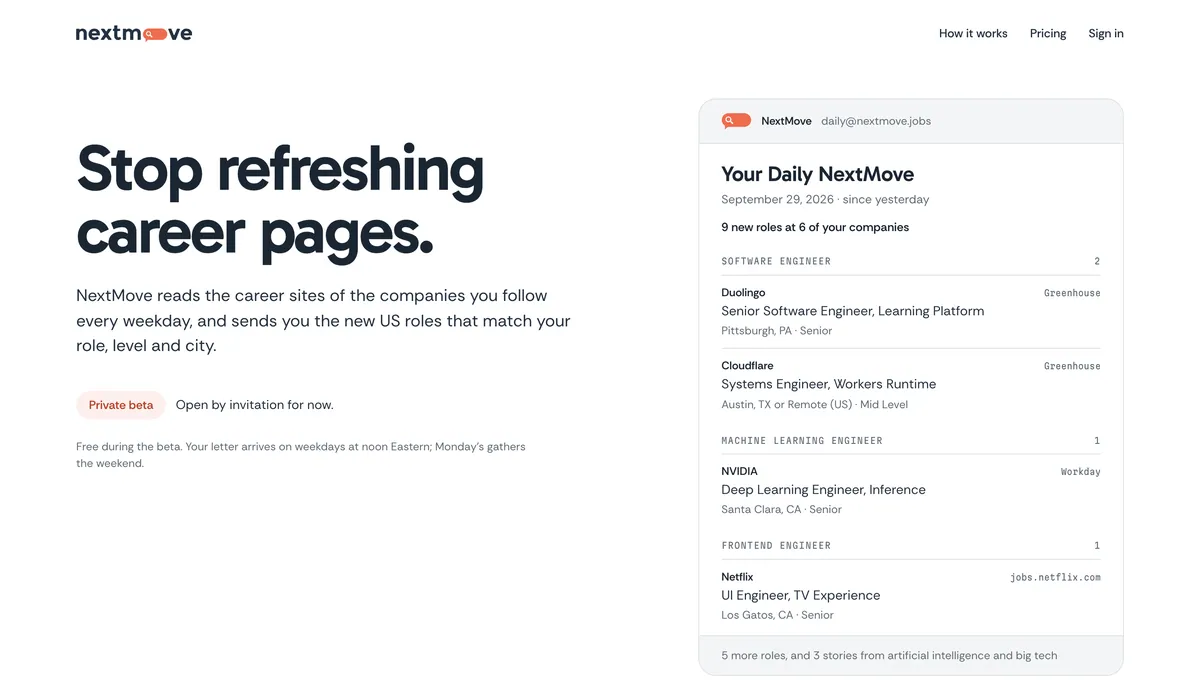
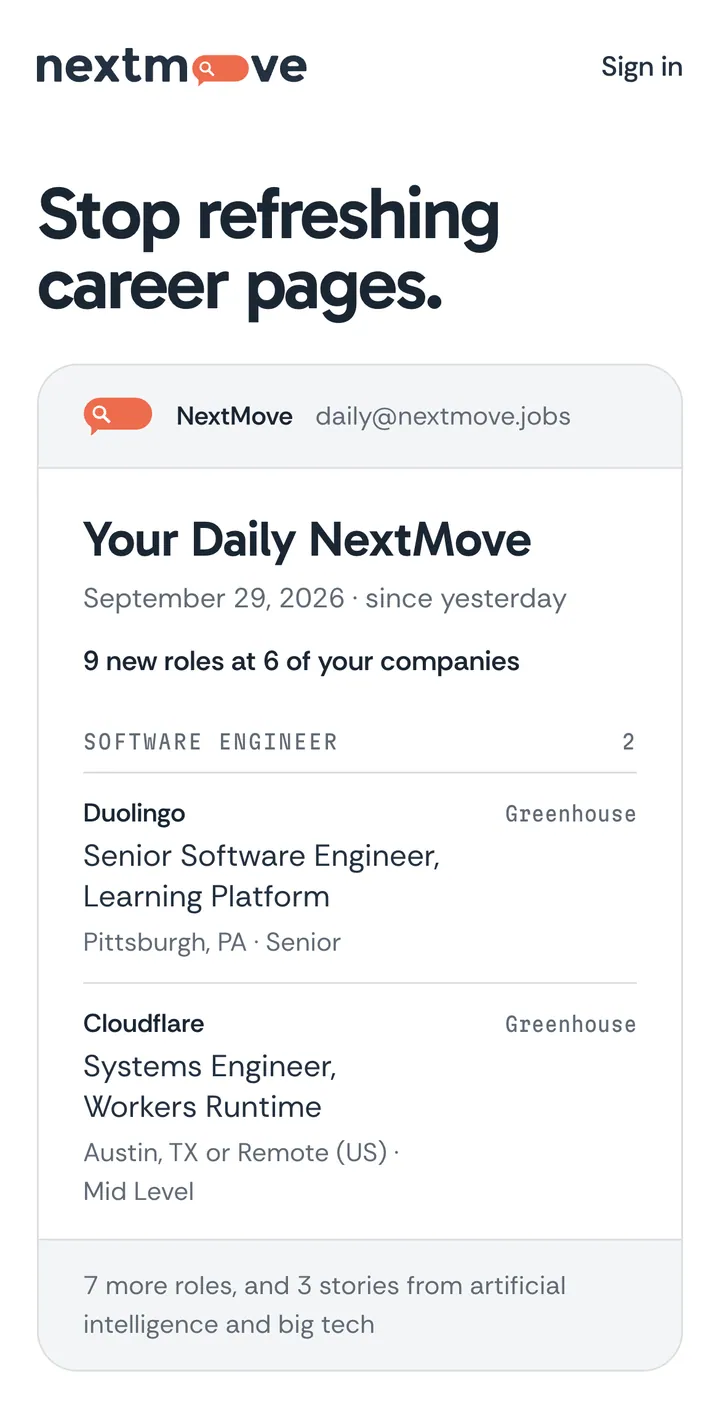
NextMove is our own product: the new US tech roles at the companies you follow, in one email every weekday. We designed it and built everything behind it, from the scrapers and the matching to the letter and the website.
In numbers
- 59 career sites integrated
- 7 scrapers for companies with sites of their own
- 5 passes before anyone sees a role
- 24 role families, from software to sales
- 4 months for the rebuild, in 2025
Counted in the code and its commit history on 29 September 2026.
Every company posts its roles in its own place, in its own format.
If you want a job at a particular company, you end up refreshing its careers page: a Workday site here, a Greenhouse board there and custom sites for the largest employers. Job boards repeat those roles later, second-hand and mixed with noise.
NextMove’s idea is simple to say. Read each company’s own career site every day, keep only the new US tech roles, and send them in one short letter, sorted by role, level and city.
The problems behind NextMove are the ones behind a busy online store.
| In NextMove | The same problem in a store | |
|---|---|---|
| Many sources | More than 50 career sites, each in its own format | Suppliers, marketplaces and a warehouse, each with its own feed |
| A source with no feed | Meta has no feed, so a headless browser reads the page | A supplier with no API is the same job |
| One clean catalogue | One name for each city, one level for each title and no reposts | One record for each product, one set of sizes and no duplicates |
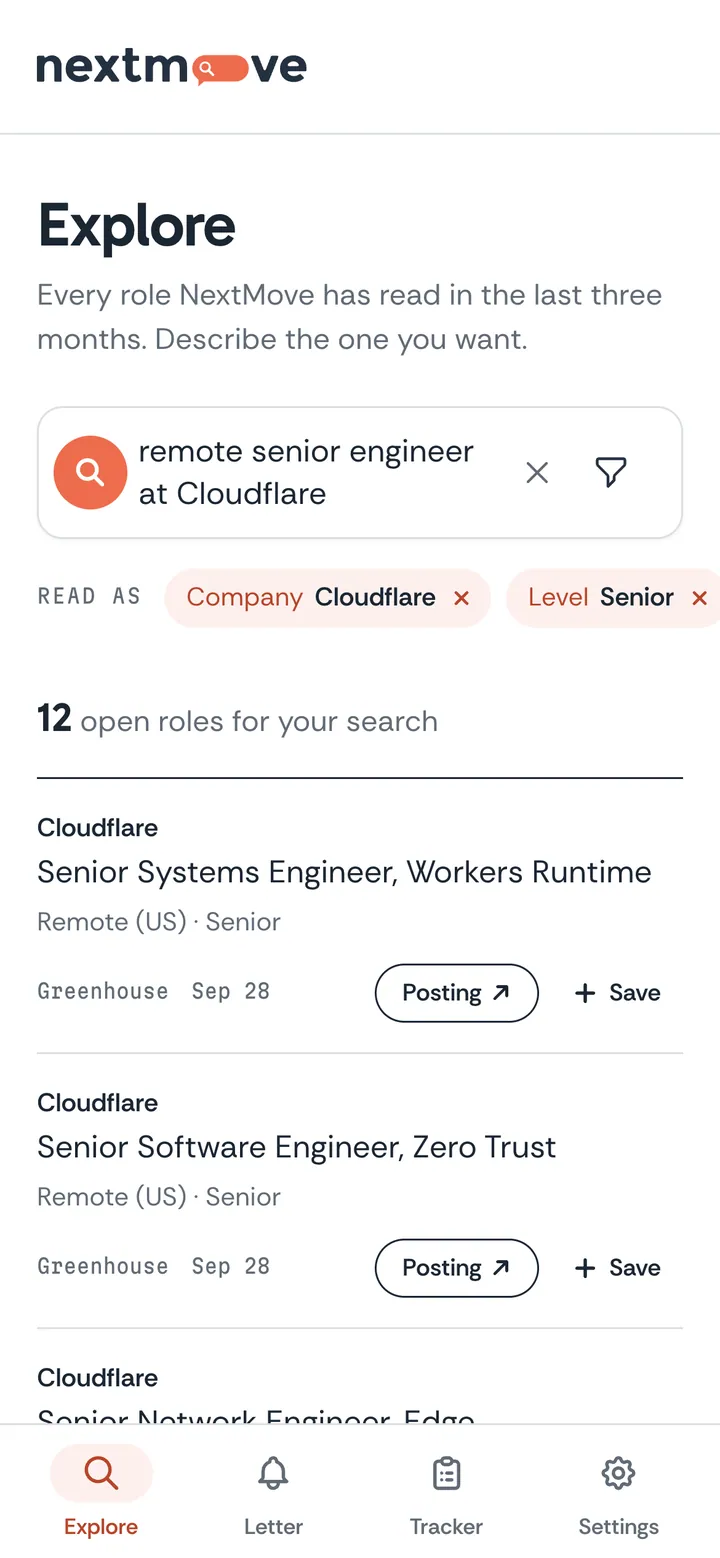
| Search | “Remote senior engineer at Cloudflare”, read into filters you can see and change | “Fragrance-free moisturiser under €30”, read the same way |
| Payments and accounts | Two Stripe plans (off during the beta), invoices, card management and verified accounts | Checkout, subscriptions and customer accounts |
| Jobs on a schedule | Read, clean, compile and send, in order, with a status page for every source | Stock, price and order syncs, in order, with a status page for every supplier |
From here the page goes into how it works, then a chapter for each thing we built. If your store has these problems, write to us; you don’t need to read on first.
The route a new role takes, from a career site to a reader’s inbox.
The stages never call each other. Each one writes to one MongoDB Atlas database, the next one reads what it wrote, and a scheduler runs them in order, so each one can be run, fixed or replaced on its own.
- Step 1
Read
59 career sites: 27 on Workday, 25 on Greenhouse and seven of their own. Chapter 02 has the details.
- Step 2
Clean and match
Reposts dropped, tech roles kept and sorted into 24 families, US only. Chapter 03 has the five passes.
- Step 3
Enrich
Places, a level, a description in one format and an estimated pay range.
- Step 4
Compile
One edition for each reader, from their companies, role families, levels and cities.
- Step 5
Send
Every weekday. Monday’s gathers the weekend.
- Branch A
The news
Split into single stories every hour, then picked for 10 industries once a day.
- Branch B
The website
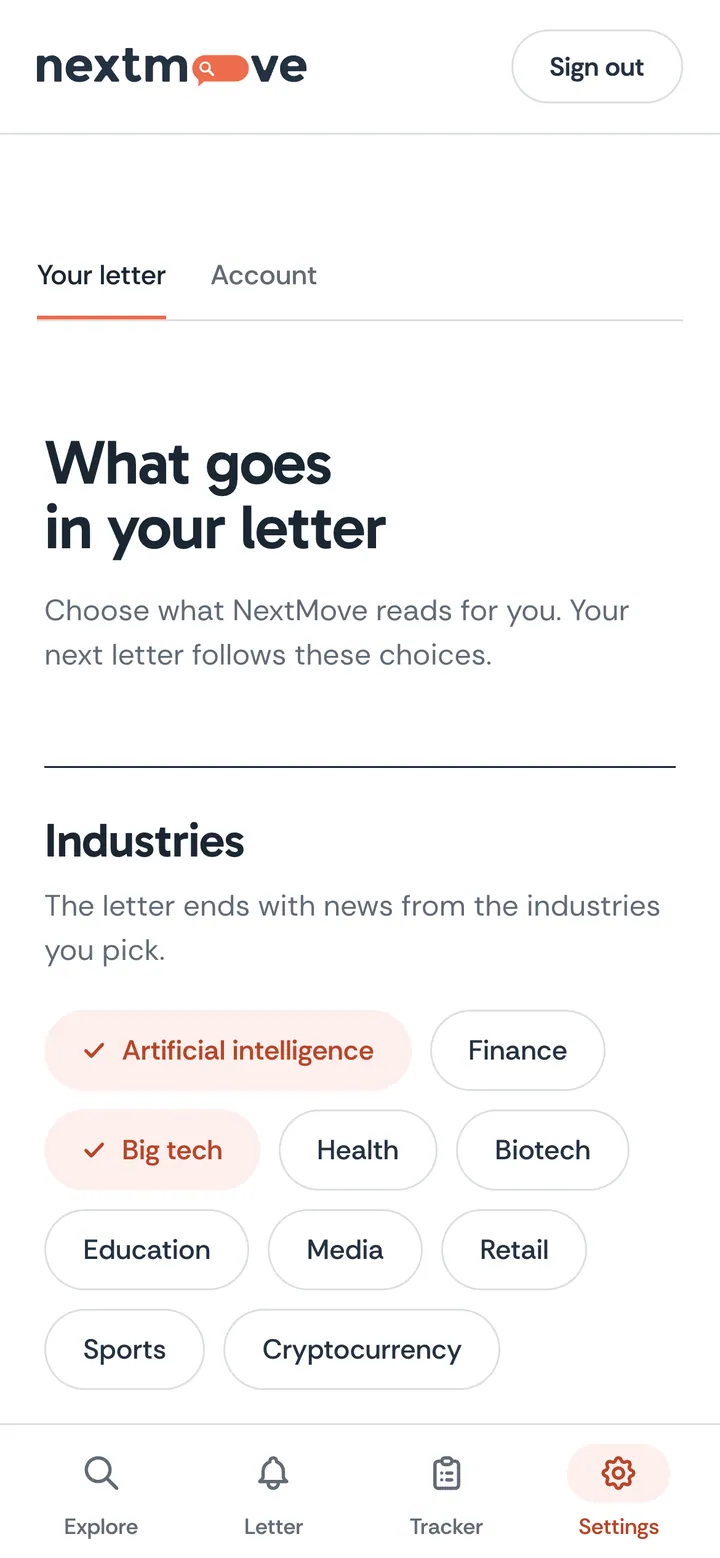
Explore searches the roles from 3 and the Letter shows the editions from 4. What a reader picks in Settings shapes their next edition.
The letter is the product, so we designed everything around it.
The website opens on a sample edition of the letter. The wordmark’s o is a search pill; grown, the same pill is the search field, and set on a rule it is the only ornament on the page. Gabarito sets the headings, Rethink Sans the text and Martian Mono the dates and data. Coral marks the one action on each page.
- Contrast
- All text on the landing and sign-in pages passed a WCAG AA contrast audit, run with axe on 29 September 2026 at a desktop and a phone width.
- Speed
- Over a slow 4G connection, with the processor slowed four times, the landing page shows its largest element in 2.1 seconds. That is the median of five runs on 29 September 2026.
The wordmark The o is the search pill.

Headings Gabarito

Text Rethink Sans

Dates and data Martian Mono


Read at the source, not second-hand.
- Integrations
- We built integrations for the two job-board platforms most of these companies use: Workday, for 27 of them, and Greenhouse, for 25. We also wrote scrapers for seven companies with sites of their own: Google, Meta, Netflix, Microsoft, Apple, Stripe and Amazon.
- Feed or page
- Where a site publishes a data feed, we read the feed. Where it doesn’t, we read the page. Meta has no feed, so a headless browser reads it.
- Generated selectors
- For Greenhouse boards and Apple, a language model writes the page selectors. Each run checks they still work before it relies on them.
- Monitoring
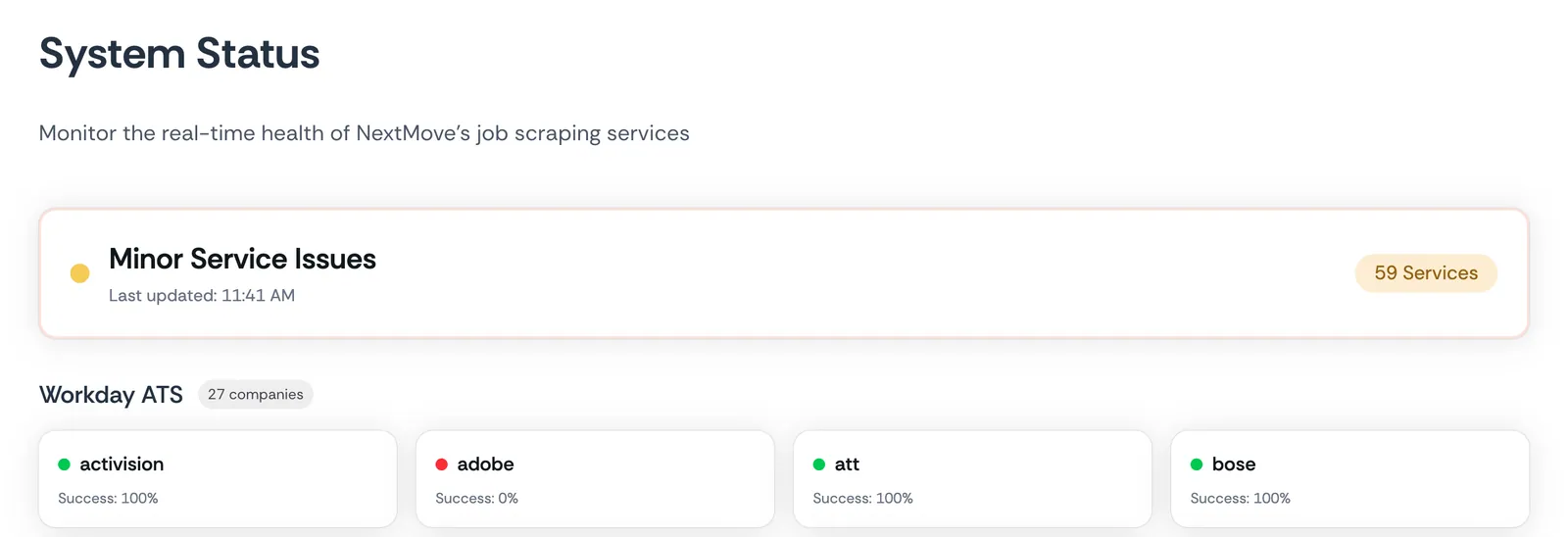
- Every run records, for each company, how many roles it found and whether it finished. The status page shows the last run of every source.
Five passes before anyone sees a role.
Duplicates
A fingerprint of company, title and places drops reposts.
Tech roles
A quick keyword pass, then a vector search that places each role in one of 24 role families, from software and machine learning to product, design, data and sales.
Relevance and place
A language model confirms each match, and that the role is in the United States.
Places
Locations are mapped to a list of 164 US cities and the 50 states. “SF”, “Bay Area” and “San Francisco, CA” become one place.
Level, description and pay
Each role gets a level (entry, mid, senior or senior leadership), a description in one consistent format and an estimated pay range.
As the career site publishes it
- Company
- Cloudflare
- Title
- Systems Engineer, Workers Runtime
- Locations
- Austin, TX; Remote - US; US-TX-Austin
- Level
- Not stated
- Pay
- Not stated
- Posted
- 28 September 2026
What the five passes found
- New: not seen before
- Software engineer
- In the United States
- Austin, TX and Remote (US)
- Mid level
As the letter shows it

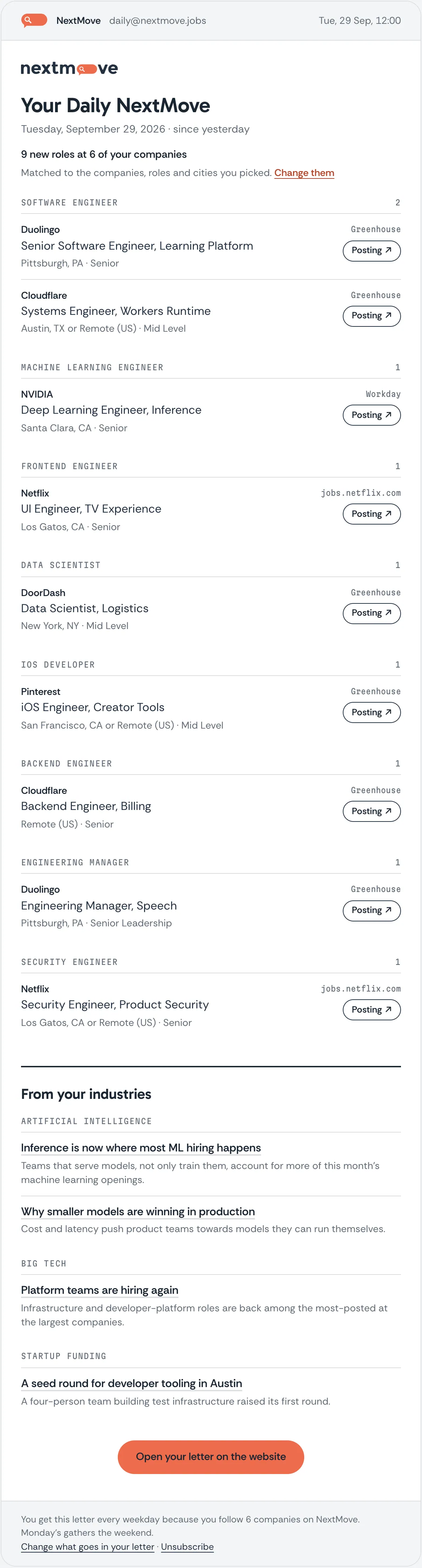
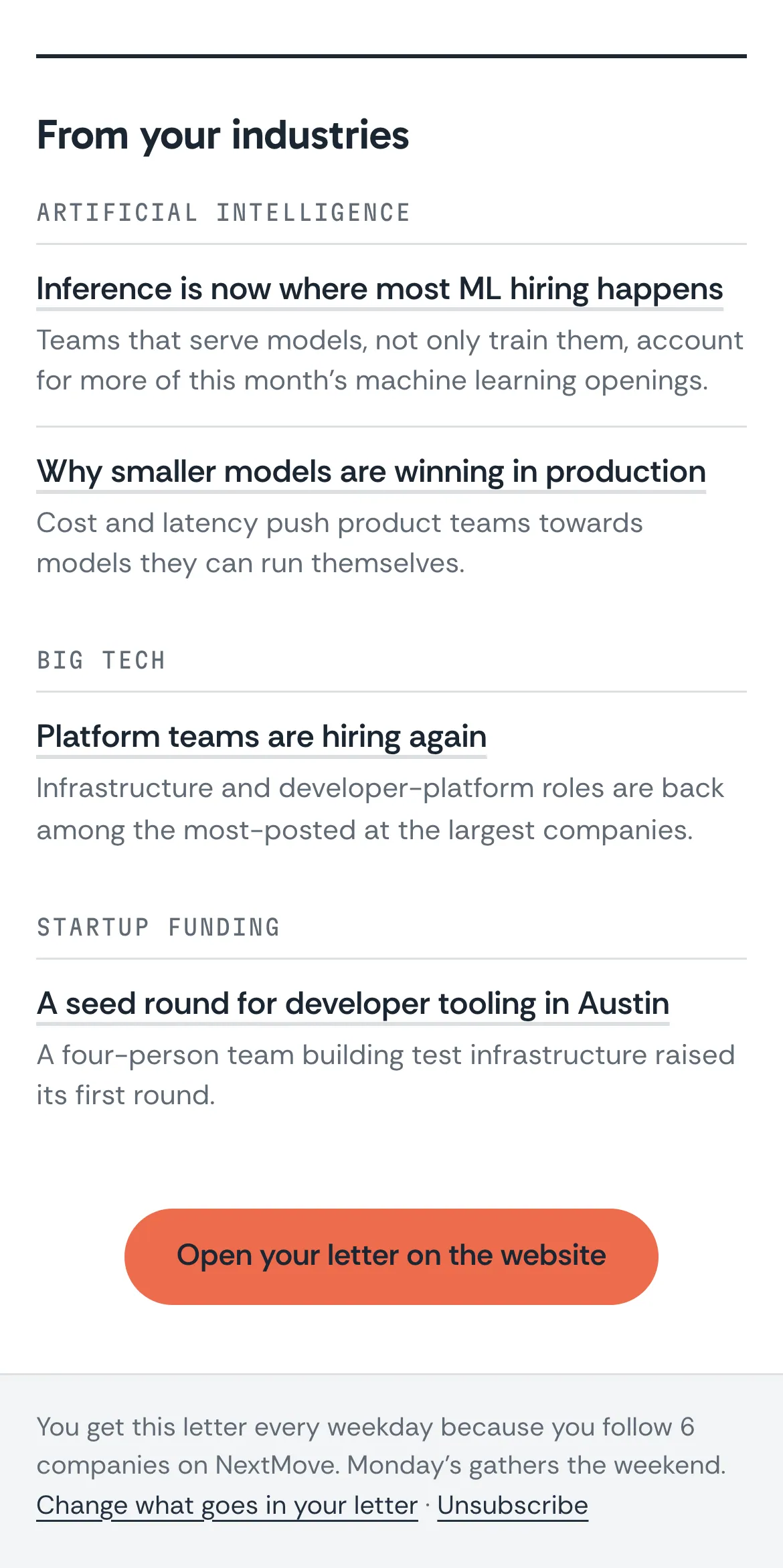
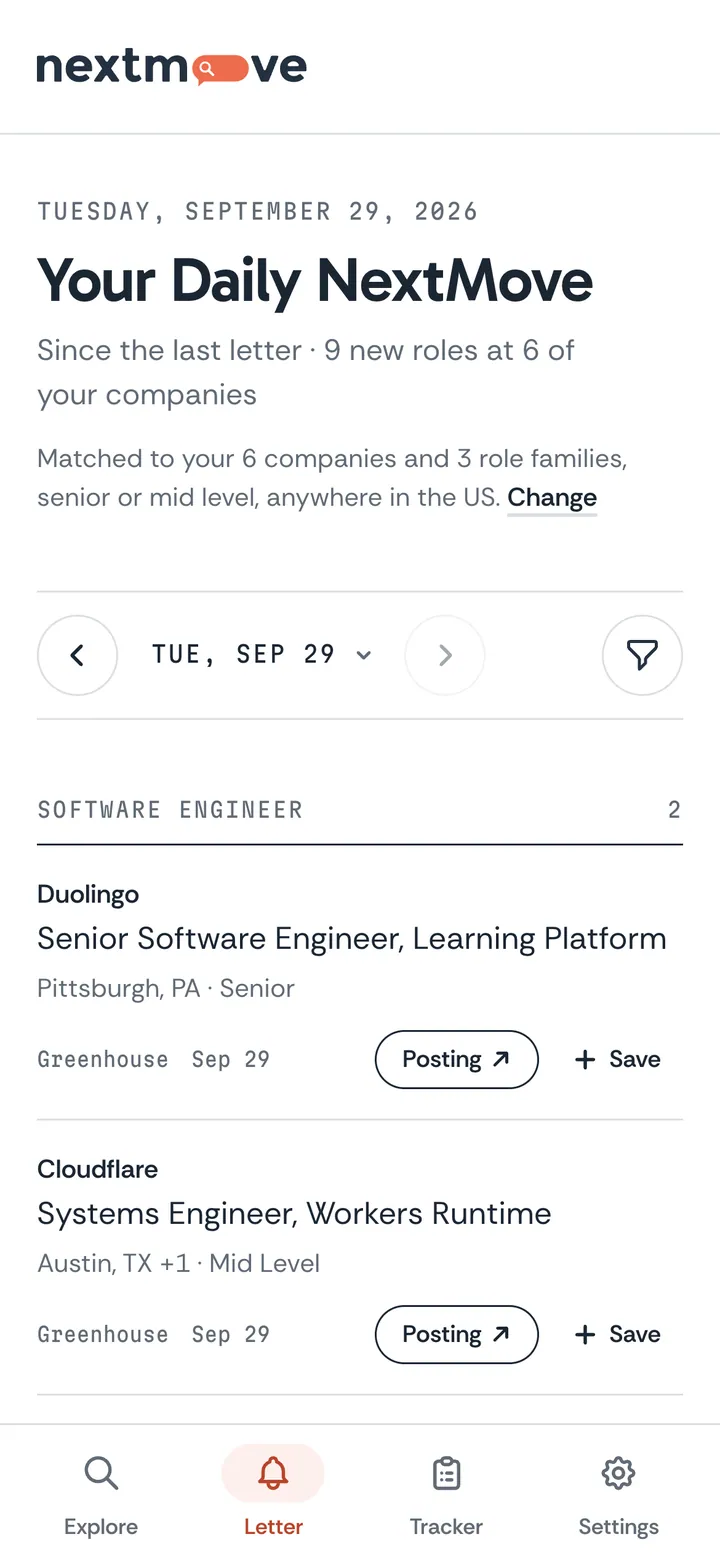
One edition for each reader, every weekday.
- Editions
- Every day we compile one edition for each reader: their companies, role families, levels and cities. It adds the day’s startup funding news and up to five stories for each industry they follow.
- Timing
- The email goes out every weekday. Monday’s gathers Friday to Sunday into one weekend roundup, with repeats removed.
- News
- The news comes from a feed of tech newsletters. A language model splits each issue into single stories, and another picks the ones that matter to job seekers in each of 10 industries.
- On the website
- The same edition appears there as the Letter, and the reader changes what goes in it from the links at the foot.
Ask for a role the way you’d say it.
- Explore
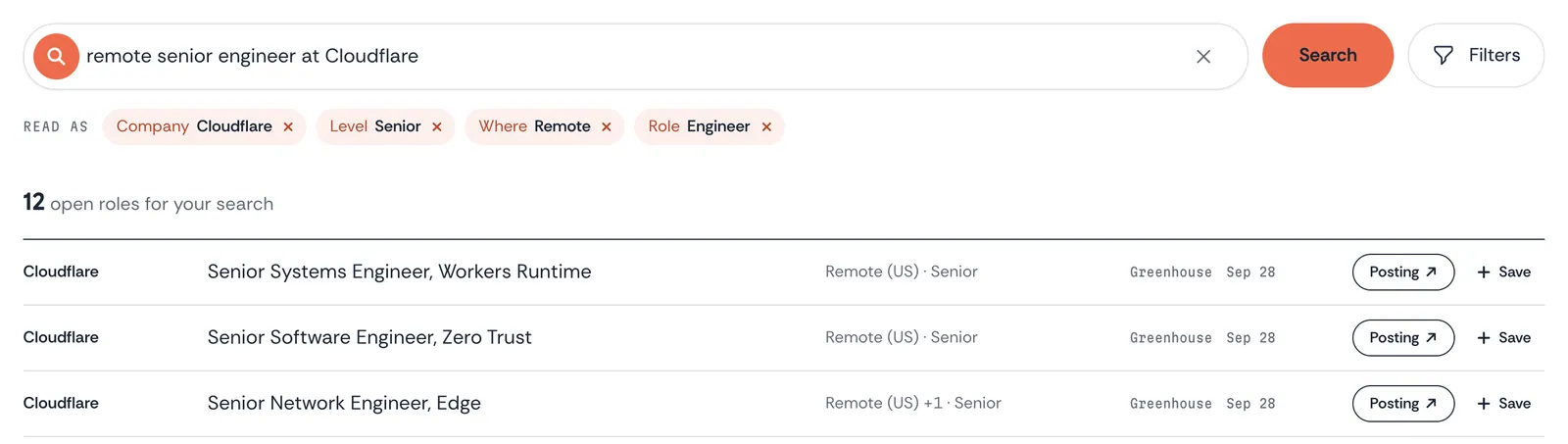
- Type a sentence such as “remote senior engineer at Cloudflare”. A language model reads it into filters you can see and change. Each plan has its own search limit.
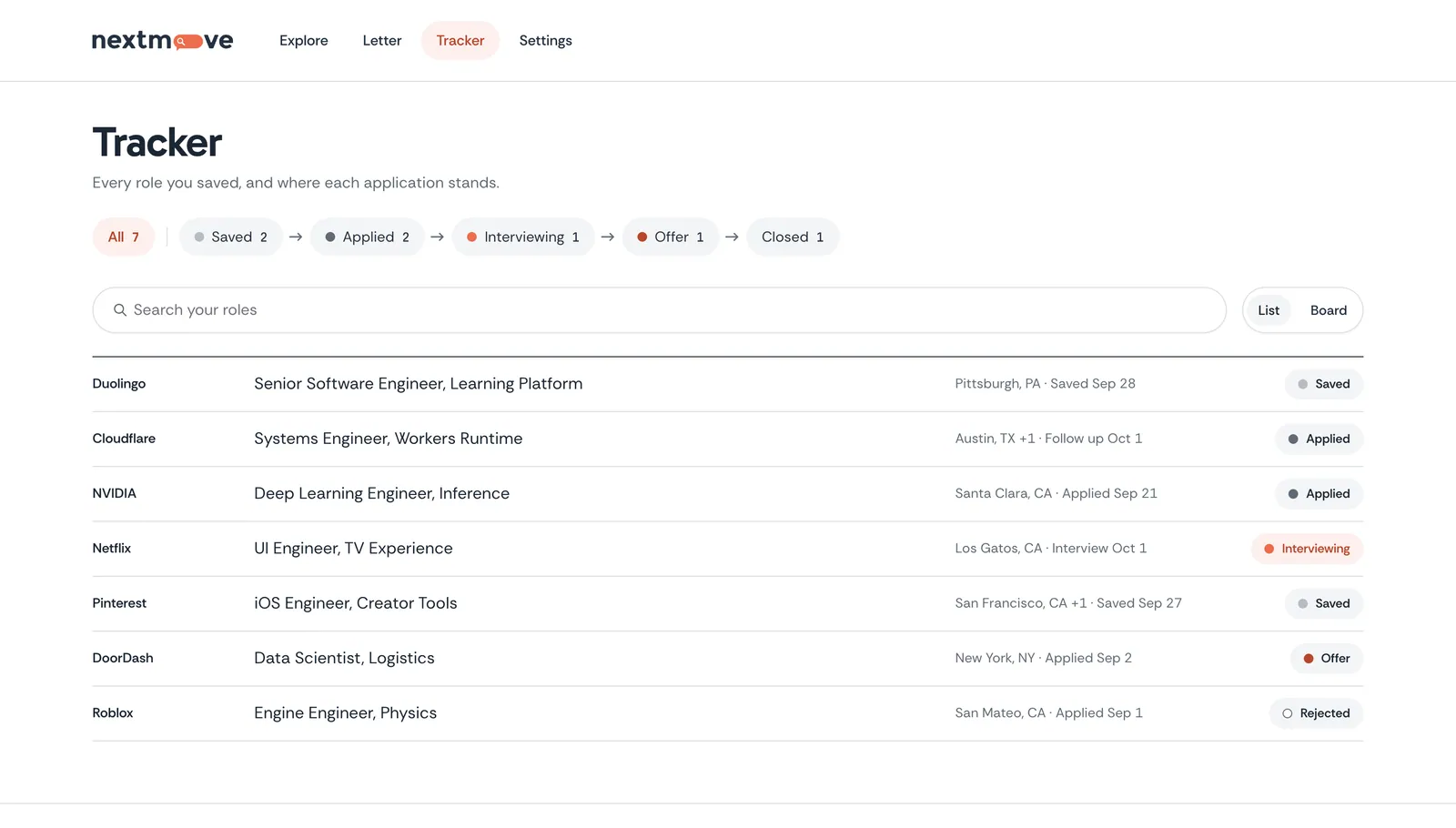
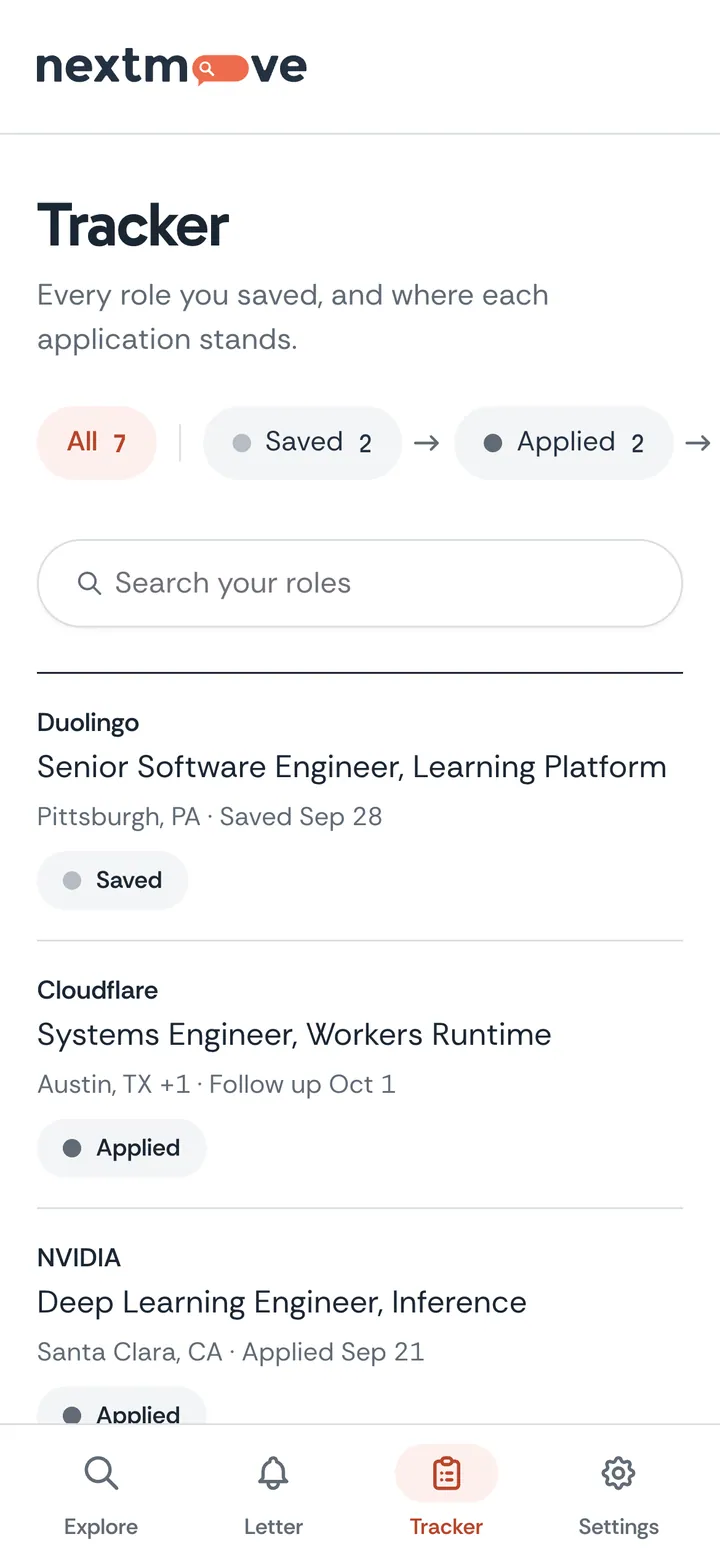
- The Tracker
- It moves each saved role from saved to applied, interviewing and offer.
- Accounts and payments
- Accounts have email verification and password reset. Stripe handles two plans, monthly or yearly, with invoices and card management. Paid plans are switched off during the beta.
Scheduled jobs run the day in order.
Scheduled jobs on Heroku run the stages in order, and each stage reads what the one before it wrote in MongoDB Atlas, whose vector search also does the matching. The website runs on Vercel and reads the same database.
A weekday, in UTC
- Step 1Read the career sites
- Step 2Step 3Clean, match and enrich
- Branch ASplit the news into stories
- Branch APick the news for 10 industries
- Step 4Compile the editions
- Step 5Send the letterat noon in New York in summer, 11:00 in winter
Built with
- The website
- Next.js, React and Tailwind CSS, on Vercel
- The daily jobs
- Python, run in order on Heroku
- The data
- MongoDB Atlas, with vector search
- Language models
- OpenAI
- Brevo
- Payments
- Stripe
A first version in 2024, and a four-month rebuild in 2025.
15 March 2024
The first scraper, for Workday job sites.
29 March 2024
The first email integration.
18 April 2024
The website starts, with accounts and a dashboard.
September to December 2025
The rebuild:
- Stripe subscriptions and Brevo email
- Companies and roles managed from the database
- Health checks for every source
- Seven custom scrapers
- The weekend roundup
- Level, place, description and pay for every role
- Explore on 3 November and the Tracker on 30 November
September 2026
The website as it is now, and the private beta.
NextMove is in private beta, open by invitation. Accounts, the letter, search and the Tracker are built. Paid plans are built too, and switched off during the beta.
- Design and engineering
- OrangeGrass
If your store pulls from many systems and needs them to agree, we’d like to hear about it.
Write a few lines: what you sell or do, what you have online now, if anything, and when you need the new site. We reply within two working days with questions, then a fixed scope and price.
While we build, you review real pages on your own phone.
Or call +381 65 300 4822.